Customer Service Agent Handoff Protocols in Retail
Poor handoffs destroy AI's value faster than no AI at all.
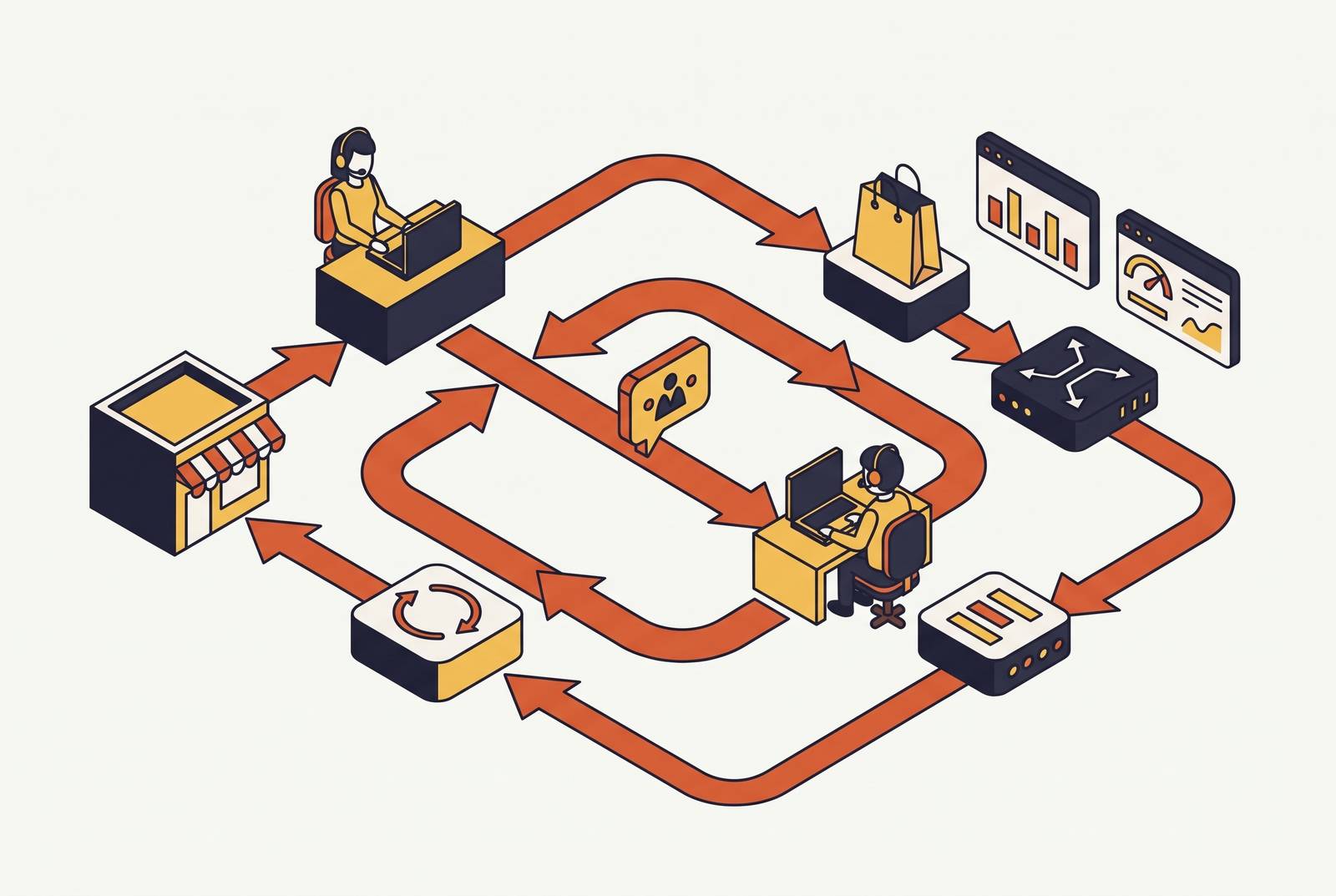
AI deployment in retail customer service runs on one assumption: automate enough of the routine volume, and the savings take care of themselves. That assumption is only half right. The other half, the part that decides whether AI helps or hurts, comes down to what happens the moment a conversation transfers, whether that's bot to human, chat to phone, or one department passing a case to another. A handoff that drops context doesn't just fail to help. It costs more trust than deploying no AI would have. One bad handoff from a chatbot does more damage than no chatbot at all: 79% of Americans say they strongly prefer talking to a human over an AI agent, 78% say switching from AI to human matters to them, and 63% say they'd walk to a competitor if that human option didn't exist. These are the baseline expectation every retail brand is up against, every single time a transfer doesn't go cleanly. They're the baseline expectation every retail brand is up against, every single time a transfer doesn't go cleanly.
The context-loss problem: what goes wrong at the moment of transfer
Picture a customer who has already explained, three separate times, that an order never showed up. A human agent finally picks up the case and opens with "Hi, how can I help you today?" That single line is the whole failure, captured in one sentence, and it's a pattern well documented in writing on handoff breakdowns.
The frustration is close to universal: 74% of consumers say repeating themselves across interactions is very frustrating. It's close to universal: 74% of consumers say repeating themselves across interactions is very frustrating. And it doesn't just annoy people, it drives them away. 54% give up when they're forced to repeat an issue multiple times, and 29% stop buying from the brand. Meanwhile the industry's own numbers show how rare a clean transfer actually is: only 15% of consumers say they've had a seamless handoff from AI to a human, and according to Twilio's research, 54% say AI agents rarely or never seem to have real context about who they are or what they already said. The gap between what companies think they're delivering and what customers actually experience is enormous, and it sits right at the transfer point.
Why retail amplifies handoff failure more than other sectors
Retail's day-to-day inquiry mix, order status, returns, refunds, the occasional payment dispute, is repetitive and high-volume, which is exactly the kind of workload AI handles well. That's the case for automation, and it's a good one.
But that same repetition hides a sharper problem. A meaningful share of what does escalate to a human is time-sensitive and charged with emotion, including a Christmas order that never arrived, a fraudulent charge on a card, or a refund that's already blown past the policy window. Retail's standard escalation categories, payment disputes, suspected fraud, lost-shipment claims, refunds past deadline, complaints that reach an executive's inbox, are all situations where losing context isn't just inconvenient. It has direct financial and relationship consequences.
The math on ticket deflection tells the same story from a different angle. In B2B SaaS, saving $10,000 by deflecting 1,000 tickets away from human agents can get wiped out instantly by $100,000 in lost revenue if just 2% of those customers churn afterward. Retail runs the identical risk wherever repeat purchases matter to the bottom line: the short-term savings from automation look great in isolation, right up until the churn bill comes due.
The business case for fixing handoffs: cost and revenue in the same frame
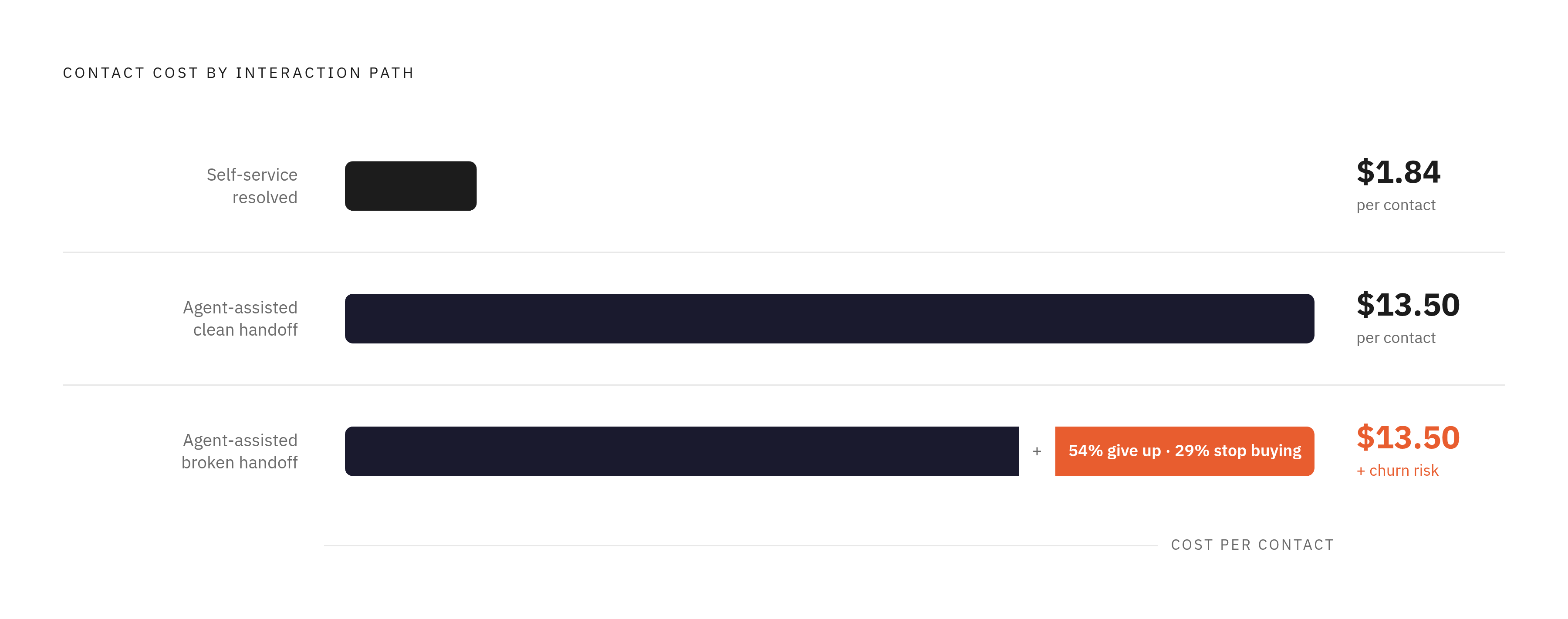
Start with the plain cost gap: a self-service interaction runs about $1.84, while an agent-assisted one runs about $13.50. That difference alone makes the case for AI automation close to self-evident.
But that gap only pays off if the handoff, when one is needed, actually works. A broken handoff turns a cheap self-service touch into an expensive, repeat, agent-staffed contact, and it does it after the customer is already frustrated, which is the worst possible time to ask a human to clean up. Gartner's research (cited by BlueTweak) shows low-effort interactions cost 37% less than high-effort ones, and they also cut down on repeat contacts and further escalations. A broken handoff is, by definition, a high-effort interaction, no matter how efficient the AI portion was. And getting it right speeds up resolution directly: agents who receive an escalation with full context resolve it substantially faster than agents starting cold.
Four trigger categories that cover most retail situations
Trigger design is about stopping a wrong answer from reaching the customer before a human ever steps in. It's about stopping a wrong answer from reaching the customer before a human ever steps in. Escalate before the AI gives a bad answer, not after, because a hallucinated response followed by a human correction damages trust twice over, once for the wrong answer and once for having to fix it.
Four categories cover almost every retail situation:
Confidence and complexity triggers fire when the AI's own classification hits a low-confidence or high-complexity threshold, so the system recognizes the edge of its own competence and routes the case proactively, before it guesses. Sentiment and emotional triggers rely on NLP to catch escalating frustration: explicit anger, the same question rephrased three or more times, short clipped replies, profanity, all-caps text. Loop detection should cap failed attempts at a small number of tries before handing off. Policy and intent-based hard rules route certain topics to a human no matter how calm the customer sounds, billing disputes, refunds above a set dollar threshold, suspected fraud, lost-shipment claims, legal or compliance questions, or any technical issue the bot has already tried and failed at twice. In retail, these rules are not optional. And customer-initiated handoffs need to work the moment someone asks: a visible "Talk to an Agent" option from the start of the conversation, never buried three menus deep, and typing "agent" should always, without exception, get a person on the line.
The common mistake is in what teams do after the trigger fires. It's in what teams do after the trigger fires. Most of the design effort goes into deciding when to escalate, and almost none of it goes into what the receiving agent actually sees. The trigger is only half the protocol.
What a complete context package looks like
Plenty of platforms claim to "pass context" between AI and human. What most of them actually pass is a raw transcript, and a transcript is not context. It's unstructured data that still requires a human to read, interpret, and reconstruct before they can act on it, which defeats the purpose.
Five things need to land on an agent's screen before they say a word to the customer: the full conversation history, verbatim, so nothing gets reconstructed from memory; the extracted entities, order number, account ID, product, any specifics the AI already gathered; a record of what the AI already tried, both answers given and actions taken, so the human doesn't repeat a failed step; the escalation reason itself, whether that's low confidence, a policy rule, a customer request, or a sentiment signal; and a structured issue summary, a synthesized description of the problem rather than a log the agent has to scroll through.
Retail adds its own layer on top, including a case ID, a reason code, whatever next step was promised to the customer, and the due date attached to it. Those four details are what let context survive not just an AI-to-human handoff, but a jump from one channel to another, or an escalation between departments. And this is where the 35 to 45% faster resolution number earns its place: it's the justification for building a structured context package in the first place, rather than treating context as a nice-to-have.
Warm and cold transfers: matching transfer type to interaction complexity
A cold transfer hands the customer, and ideally the context package, to whichever agent is next in the queue. A warm transfer briefs the human first, before that agent ever engages the customer directly.
Treating warm and cold as a strict either/or misses the point. It's a spectrum, and where a given interaction sits on it should track the complexity of the issue. Low-complexity, low-emotion cases, a routine return inquiry, work fine as a cold transfer, as long as the context package behind it is well-built. Higher-complexity cases, or ones where emotion is climbing, need a richer summary and clearer framing before the agent says anything. And sensitive, urgent, or regulated situations, suspected fraud, a lost-shipment claim, anything with legal exposure, call for a warm transfer with priority routing and a specialist who's already been briefed before the customer even lands. A return inquiry routed cold with good context behind it is a non-event. A customer disputing a fraudulent charge after three prior contacts is a different animal entirely, and treating it like the first case is how trust erodes.
Channel matters here too. In chat, the context package can sit in the agent's interface before they type a single word. In voice, a warm transfer often means an actual briefing moment happens before the call even connects. Cross-channel handoffs, chat to phone, or phone to a follow-up email, are the hardest case, because the case ID and reason code have to survive the jump between systems that often don't talk to each other well. Right now, only 7% of contact centers manage that cleanly.
Agent-to-agent and department-to-department handoffs: the same rules, often ignored
Most of the conversation around handoffs centers on AI-to-human transfers, but retail customers get passed around constantly between humans too: shift changes, specialist routing, a case that moves from customer service to fraud, to logistics, to finance, or from a sales rep to whoever handles the account after the sale closes.
The principle doesn't change just because both sides of the handoff are human. The agent picking up the case needs structured context waiting for them instead of a prompt to ask the customer to start over. The parallel from sales-to-customer-success handoffs makes the stakes clear: a large share of customers expect a consistent experience across departments, yet most of these transitions still run on scattered notes, half-updated CRM fields, or a rushed message typed in the last five minutes of a shift. The context that gets lost in that gap creates churn risk before the customer has even gotten any value from whatever they were promised.
What has to travel in any agent-to-agent handoff is the same list as the AI-to-human package: the current state of the issue, what's already been tried, any commitment made to the customer, the next step, and the deadline attached to it. The channel changes. The requirement doesn't.
How leading platforms handle handoff context in practice
Platforms don't really differ on whether they escalate. Nearly all of them do. Where they differ is how much control a team has over the escalation logic itself, and what the receiving agent actually sees once the handoff happens. Voiceflow's July 2026 guide lays out four platforms on exactly these terms.
Voiceflow is model-agnostic: a team can plug in OpenAI, Anthropic, Google, or bring its own model. On a warm transfer it passes the full transcript, customer data, and an AI-generated summary, and escalation triggers, intent, sentiment, complexity, low confidence, explicit request, are fully defined by the team building the agent, not fixed by the platform. It connects to existing helpdesk or live-agent tools, Salesforce, Zendesk, any REST API or MCP-connected system, and it prices on usage-based credits, a subscription base plus per-interaction credits, with a free tier available. It fits teams that want to build and own the agent and decide for themselves exactly when and how it hands off.
Fin, from Intercom, runs on a proprietary model with no option to bring your own. It shares the same customer record with the receiving agent and makes an AI summary available, using a mix of rules and plain-language guidance with sensible defaults for frustration, repeated loops, and explicit requests to speak to someone. A human picks up inside Intercom's Inbox, or the host helpdesk if Fin is running standalone, and pricing runs $0.99 per resolution, scaling with volume. Fin is currently being acquired by Salesforce and is set to fold into Agentforce.
Ada runs on its own Reasoning Engine, built on top of multiple underlying LLMs including OpenAI and Google's models, but Ada manages model selection itself, with no customer-facing choice. It passes the transcript, mapped customer information, and an AI summary, using triggers based on both reasoned intent and set rules, then routes into whatever helpdesk the business already runs, since Ada doesn't function as a helpdesk on its own. Pricing is custom, sales-negotiated. It's built for teams chasing resolution rate above everything else.
Sierra is multi-model as well, with Sierra itself handling the orchestration and no model choice exposed to the customer. It generates an automatic summary for the team taking over, with triggers set through goals and guardrails that aren't publicly detailed in much depth, and it routes into whatever helpdesk or CX stack is already in place. Pricing is outcome-based and custom. Sierra positions itself as a managed, hands-on option for large enterprises with the budget to match.
The real differences across all four come down to control and cost: a team can pick its own model and write its own escalation logic, or it hands that decision to the platform, and the bill is either a flat platform fee or tracks every single resolution.
Sources
- AI-to-Human Handoff: Best Practices for Support Escalation in 2026
- Best Enterprise AI Customer Service Platforms for Human Handoff
- Sales to Customer Success Handoff: A Complete Guide (2026)
- How to Fix AI Customer Service Agents Failing at the Handoff by Virtasant
- How To Manage The AI-To-Human Handoff | The Works | Freshworks
- Contact Center Leaders Think They Fixed the AI Handoff. They Didn't