Natural Language Constraint Parsing in Shopping Agent Inputs
Shopping agents must parse casual requests into structured constraints they can actually enforce.

- Written by
- Priya Subramaniam
- Published
- October 16, 2026
- Reading time
- 10 min read
- Sources cited
- 6 sources ↓
What this covers
A single shopping prompt is never a single instruction. "I need a birthday gift for my sister, she likes skincare, budget $75, needs to arrive by Friday" encodes product category, recipient persona, price ceiling, delivery deadline, and occasion simultaneously, none of them labeled as such. What a shopper compresses into one casual sentence, an agent must expand into a structured set of executable constraints. The gap between those two representations is where most current failures live.
Why natural language shopping inputs are structurally multi-constraint problems
The prompt may look simple, but it has five constraint layers at once. The agent must identify a product category, constrain it to skincare, cap the price at a budget the shopper has set, ensure a delivery window that beats Friday, and recognize that "birthday gift for my sister" modifies everything downstream. A gift purchase has persona constraints that a personal purchase does not: the recipient's preferences, not the buyer's, govern relevance. None of these constraints arrive with explicit labels. The shopper does not say "attribute constraint: category equals skincare; numeric constraint: price less than or equal to 75." The agent must infer that structure from conversational prose.
Traditional keyword search externalizes this filtering work onto the shopper. A user enters "skincare gift set under $75" and then manually applies faceted filters, sorts by delivery date, skims reviews for sensibility to recipient age, and weighs the occasion against the options returned. The search engine handles matching. The human handles constraint enforcement. The shopper has delegated not just retrieval but constraint reconciliation, and the cost of any dropped constraint lands on a purchase decision rather than a search results page.
Multi-turn dialogue compounds the structural burden further. In a conversation, constraints surface gradually. A shopper might open with "I need a birthday gift," specify "my sister, she likes skincare" a turn later, name a budget a turn after that, and only mention the Friday delivery deadline when the agent proposes a product with shipping times that miss it. The constraint set grows as the dialogue progresses, and each new constraint must be reconciled against every constraint already established. Gao et al. identify this as an interaction-level personalization problem: the system must remember, reconcile, and operationalize user constraints over time, not just respond correctly turn by turn. The structural implication follows directly. Parsing a shopping input is not a single classification step. It is a decomposition pipeline: the agent has to identify constraint types, fill missing slots, and prepare machine-executable parameters that downstream systems can enforce.
The constraint taxonomy agents must actually handle
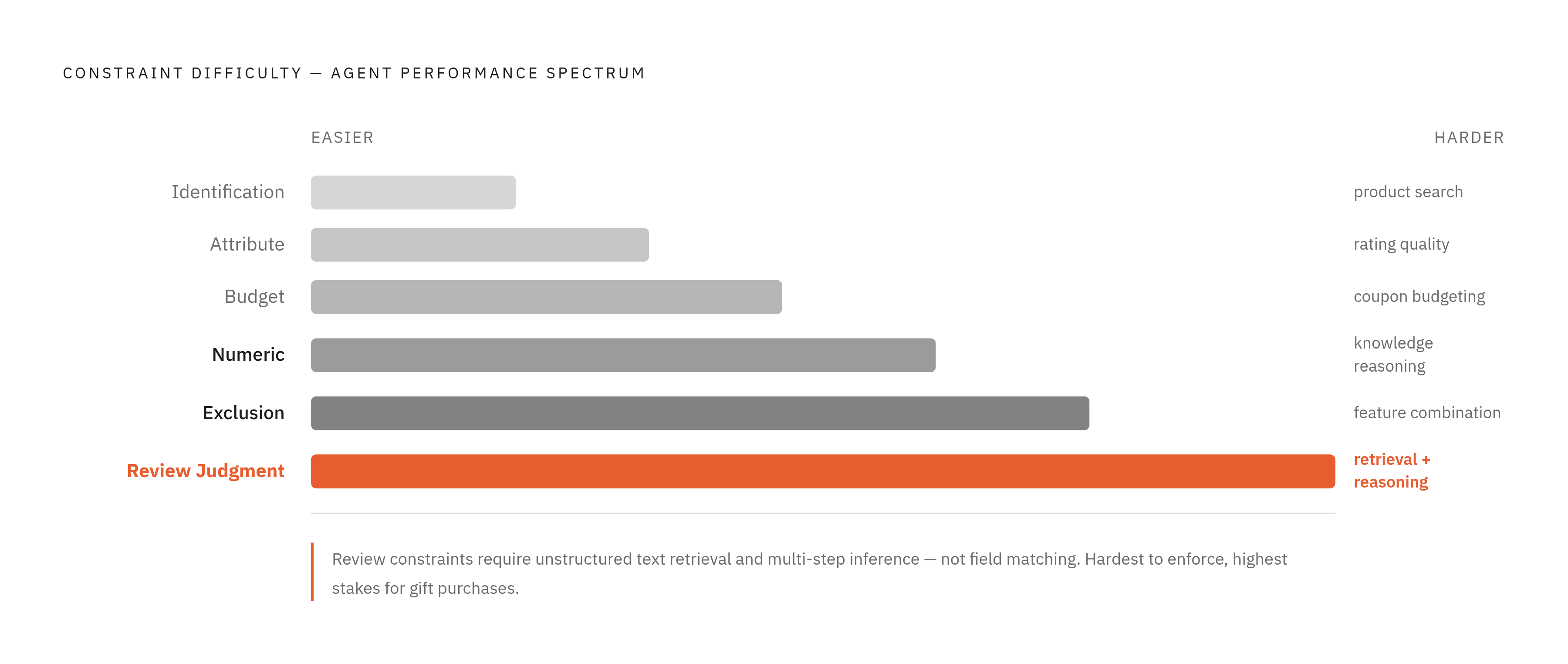
Empirical work on shopping agents has converged on a taxonomy of six distinct constraint types: identification, attribute, numeric, exclusion, budget, and review judgment. The significance of this taxonomy is not that it catalogs every possible constraint, but that agent performance varies so sharply across the categories. Constraint type turns out to be a better predictor of failure than model size alone. A model that handles attribute constraints flawlessly can still fail systematically on exclusion constraints or review-driven judgments, and this holds across architectures.
Consider budget constraints in isolation. Agents that conflate these two return constraint violations even when they appear to be following the shopper's price instruction to the letter. The difficulty ordering that research has documented maps this roughness: product search, rating quality, and coupon budgeting rank as easier tasks, while knowledge reasoning, review-driven shopping, and feature combination rank as harder, and the order persists across models.
Review-driven constraints are qualitatively distinct from attribute constraints. An attribute constraint matches against a structured field. For a review-driven constraint, the agent has to retrieve, read, and reason over unstructured text. "Giftable for a sister in her twenties" is not a field on a product page. It is an inference drawn from how reviewers describe recipients, how products are positioned, and what occasions the packaging and format imply. So review constraints are a retrieval and reasoning problem, not merely a parsing problem. Implicit and persona-level constraints such as gift recipient, occasion, and lifestyle fit do not even appear in the taxonomy as hard filters, but they govern whether a recommendation is actually useful. They are the constraints most likely to be dropped under retrieval pressure, because nothing in the pipeline forces their enforcement.
How agents decompose a prompt into executable parameters
For any buyer query, the agent follows a sequence of operations. The pipeline has distinct, inspectable stages, and each stage can fail on its own. That independence is what makes failure analysis tractable, and it is also what makes failures so easy to compound.
Amazon's Alexa for Shopping, the renamed successor that merged Rufus with Alexa+ as of May 13, 2026, shows what structured decomposition looks like in a production system. The product is not a single model that does everything at once. It is a set of capabilities wired to different stages in the constraint pipeline.
The pipeline has a precondition that is easy to overlook: it only works when the underlying product metadata exposes the fields the agent needs. A visually clear product page that does not expose shipping timelines or return conditions as structured fields cannot reliably be evaluated by the agent, no matter how capable the model behind it is. The agent's understanding is bounded by the data it can query, and a page that communicates clearly to a human shopper in rendered text may be entirely opaque to the agent parsing it.
Where the pipeline breaks: enforcement failures versus understanding failures
The prevailing assumption in the industry is that better language models will solve constraint parsing through richer semantic understanding. The benchmark evidence contradicts this directly. Capable models often understand a constraint and then violate it during retrieval and selection. The failure is not in comprehension. It is in execution, and the two are separable in ways that model scaling does not address.
ShoppingBench, from Wang et al. in August 2025, provides the empirical profile. An ACL 2026 analysis of agent behavior sharpens the picture: agents tend to ignore key attributes, underutilize existing results in retrieval, weakly enforce constraints in product selection, and make hasty purchase recommendations without sufficient user interaction. The same paper identifies a personalization imbalance, in which agents simultaneously underuse and overconstrain preference information across trajectories. The model knows the preference exists and applies it erratically, sometimes too little and sometimes too rigidly, with no consistent pattern to correct against.
DeepShop, from Lyu et al. in June 2025, shows where this split manifests by constraint type. The rule that emerges is direct: the harder the enforcement mechanism, the worse the compliance. This is an optimization artifact, not a comprehension failure. Under retrieval pressure, agents satisfice on the most salient constraint, which is usually price, and deprioritize harder-to-verify constraints such as review-driven requirements and implicit persona fit. The mechanism is well understood even where the solution is not.
ShoppingComp's expert-curated benchmark reinforces the point from a different angle. The best model achieves roughly half the human F1 score, and the gap widens on tasks that need cross-source reasoning. The pattern holds across independent evaluation frameworks with different methodologies, which is what makes it a structural finding rather than a benchmark artifact.
How multi-turn conversations make constraint tracking harder over time
In a multi-turn shopping conversation, the constraint set is not static. It grows, and sometimes it conflicts across turns. Systems that handle individual turns well can still fail at trajectory-level consistency, and the gap is invisible to standard evaluation that scores each turn in isolation. A response can be locally relevant to the current turn while ignoring a preference or constraint stated two turns earlier. This is the difference between turn-level correctness and long-horizon alignment, and it is the axis where current systems are weakest.
Gao et al. demonstrate the failure mode directly. Static user profiles make this worse. They keep user representations fixed and cannot adapt to constraints revealed mid-conversation, while per-turn retrieval improves local relevance but does not control how preference evidence accumulates and gets enforced across a full interaction.
The multi-agent RAG framework offers one structural response. Evaluation along four trajectory dimensions, named Global Preference Consistency, Cumulative Information Synthesis, Interaction Trajectory, and Tone Consistency, captures whether the agent maintains the full constraint set over time rather than whether each individual turn is correct. The architectural intervention changes what gets measured, and the measurements improve.
But the problem extends further than a single conversation. The use of RLVR aligns training closely with downstream task performance. The structural challenge is constant: constraint state grows while context capacity is finite, and every solution must address that tension directly.
The clarification dilemma: when to ask versus when to infer
Multi-turn constraint tracking creates a design tension at the interaction level. When the agent encounters ambiguity, should it ask the user to clarify, or should it resolve the ambiguity silently and proceed? There is no empirically dominant strategy. If you ask early, ask late, or infer silently, you get different constraint satisfaction profiles and different user experience outcomes, and the best choice depends on constraint type and model architecture.
Early clarification reduces downstream enforcement failures by narrowing the constraint set before retrieval begins. The agent guesses, and the guess either works or it does not. The risk concentrates differently: if the inference is wrong, the error propagates through retrieval and selection without any correction opportunity until the user sees a wrong recommendation and must correct after the fact.
For system design, the practical implication is a constraint-type-aware strategy rather than a global one. Current systems handle it inconsistently, and the research does not support a prescriptive answer. What it supports is the recognition that the tradeoff is real and must be designed for explicitly rather than left to emerge from model behavior.
How the agent-merchant interface determines what constraints can be enforced at all
Even a capable agent cannot enforce a constraint if the underlying product data does not expose it as a structured, consistent, machine-readable field. Data architecture therefore sets a hard ceiling on constraint parsing quality, and that ceiling is a merchant and platform problem as much as a model problem. The interface between agent and product data matters as much as the model itself.
The collapse scenario is specific and common. The product is excluded from the candidate set not because it fails the constraint, but because the constraint cannot be checked against it. Gembah's 2026 guide frames this as a product development issue: collect specifications, materials, dimensions, and compatibility details from approved sources at development time, treating accurate structured data as a prerequisite for agent visibility rather than an afterthought.
Consistency across surfaces matters for a specific reason: agents cross-reference. Optimizing for agentic visibility means treating product metadata as the primary product-facing artifact, not the storefront design. The aesthetic page that converts human shoppers may be invisible to the agent that otherwise would have recommended it.
What shopping agent benchmarks reveal about the gap between lab performance and real purchasing decisions
Across independent benchmarks with different methodologies and different task constructions, the same failure hierarchy emerges. Single-constraint, attribute-matching tasks are tractable. Multi-constraint, inference-heavy, and basket-level tasks remain substantially unsolved even by the most capable current models. The pattern matters more than any individual score.
ShoppingBench, with 3,310 user instructions and more than 2.5 million real-world products in a sandbox across four intent classes, shows the best result on overall absolute success rate below half, with constraint violations and attribute mismatches as the dominant failure modes. Model capability improvements help on simpler constraint classes but give you diminishing returns on the hardest ones. That suggests the remaining gap is structural, located in data quality, interface design, and clarification strategy, rather than purely a function of model scale.
What the current limits mean for buyers, sellers, and anyone building shopping infrastructure
The enforcement gap between constraint understanding and constraint execution is not just an abstract benchmark problem. It produces tangible downstream effects for every party in a shopping transaction, and the effects scale with the social importance of the purchase. For buyers, a constraint violation is not a quirky AI slip. Implicit and persona-level constraints are the ones most likely to be dropped, which means the recommendations most likely to fail are the ones that matter most socially: gifts, personal care, compatibility-dependent purchases. The agent that gets a commodity purchase right but a gift purchase wrong has failed precisely where delegation would have helped the most.
For sellers, constraint parsing creates an invisible qualification gate upstream of any ranking. Data completeness is thus a distribution problem, not just an SEO problem. A seller who optimizes the storefront for human shoppers but neglects the metadata layer has built a store the agents cannot see.
For platform and infrastructure builders, the interface layer sets the ceiling. The honest conclusion is measured. The gap is partly a model problem and partly a data and architecture problem, and the data and architecture part is more actionable today.
Methodology & sources
- Product SEO for 2026: Get Found by AI Shopping Agents
Provided the merchant-side guidance on treating structured product metadata as a prerequisite for agent visibility, cited in the agent-merchant interface section.
- Personalization Matters: Long-Horizon Conversation Agent with User-Centric Information in Online Shopping Interactions
Supplied the multi-agent RAG framework and four trajectory evaluation dimensions (Global Preference Consistency, Cumulative Information Synthesis, Interaction Trajectory, Tone Consistency) discussed in the multi-turn tracking section.
- ShoppingBench: A Real-World Intent-Grounded Shopping Benchmark for LLM-based Agents
Provided the ShoppingBench dataset details (3,310 instructions, 2.5 million products, four intent classes) and the finding that best overall success rates fall below half.
- Customer-Agent: Overcoming Context Limitations in Ultra-Long Shopping Trajectories via Tool-Augmented Agents and RLVR
Provided the RLVR training alignment approach for long shopping trajectories mentioned in the multi-turn constraint tracking section.
- DeepShop: A Benchmark for Deep Research Shopping Agents
Sourced the DeepShop benchmark findings from Lyu et al. showing that harder enforcement mechanisms yield worse compliance across constraint types.
- ShoppingComp: Are LLMs Really Ready for Your Shopping Cart?
Provided the ShoppingComp expert-curated benchmark result showing the best model achieves roughly half the human F1 score, with the gap widening on cross-source reasoning tasks.