Product Search and Filtering Accuracy in Shopping Agents
Shopping agents eliminate products before ranking them, making data accuracy a survival question.

- Written by
- Priya Subramaniam
- Published
- October 9, 2026
- Reading time
- 10 min read
What this covers
Shopping agent accuracy depends on a filtering process most merchants have never had to think about, because search engines never required it. It doesn't show a shopper ten options and let them choose. It decides, before any human sees a result, which products survive and which disappear.
Why shopping agents filter differently than search engines
A keyword search engine ranks. A product with a thin description, a missing spec, or an outdated price still shows up somewhere on the page, just lower down, where a patient shopper might still find it. A shopping agent doesn't work that way. It eliminates. A product that fails to meet a stated constraint doesn't get buried, it gets dropped, and the shopper never learns it existed. That difference in mechanism changes what merchants are actually competing for. In keyword search, the competition is for a click, won through position on a page. In agentic commerce, the competition is for survival through a filter, won or lost before ranking even starts.
Consider a query like "waterproof hiking boots under $150 that arrive by Friday." That single sentence carries three hard constraints at once: a price ceiling, a feature requirement, and a delivery deadline. Each one has to be matched before the agent even begins to think about which boots are better than which other boots. The four-stage flow that paz.ai describes for agentic commerce, intent capture, discovery and matching, evaluation and recommendation, and transaction execution, runs in strict sequence, and it loses products along the way. A pair of boots that fails the discovery and matching stage never reaches evaluation. It simply isn't in the running anymore.
Human shoppers forgive ambiguity. A shopper who can't find the exact weight of a boot will often assume it's reasonable and move on. An autonomous agent checking that same page extracts what it can parse and excludes what it can't. A missing or contradictory attribute doesn't cost a product a few ranking positions, it costs the product its spot in the result set. So filtering accuracy becomes a revenue question for merchants, not an SEO exercise. A product can have excellent reviews, a competitive price, and fast shipping, and still never reach a shopper if one unparseable attribute knocks it out in the first pass.
Running agent filtering in three layers
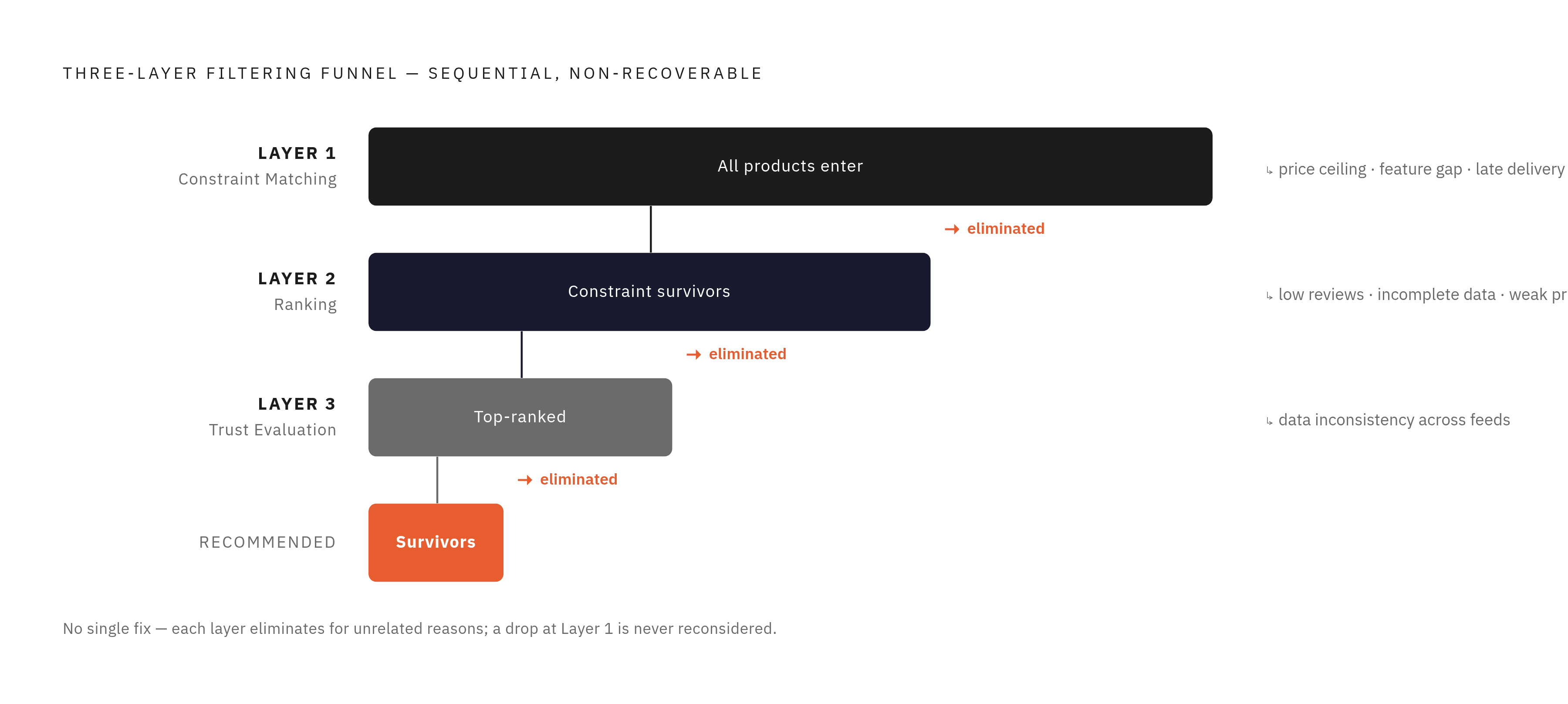
Agent filtering runs in three distinct layers, each with its own logic, and a product can be dropped at any one of them for a completely different reason.
The first layer is constraint matching. The agent pulls hard requirements out of the natural-language query, things like price ceiling, size, compatibility, and delivery window, and checks each one against the product attributes it can actually read. A query carrying a price limit, a feature requirement, and a delivery deadline is treated as one compound filter, and every constraint has to clear at once. Compatibility is where this breaks down most often, because merchants tend to describe it loosely. A phrase like "fits most standard models" means something to a human reader willing to take a chance. To an agent, it's unparseable, and unparseable means excluded.
The second layer is ranking, and it only applies to products that already survived layer one. Here the agent orders the surviving candidates by conversion signals: review quality, how complete the structured attributes are, how the price compares to competitors, and how reliable fulfillment has been. Review handling here is more granular than a star average. Agents increasingly pull attribute-level sentiment out of review text itself, reading for mentions of battery life, ease of assembly, or durability. Page content matters at this layer too, because LLM-based agents build the rationale they give a shopper out of what's actually written on the page. A structured "Best For" block, written in plain use-case language, shapes how the agent describes the product back to the person asking for it.
The third layer is trust evaluation, and it's the least forgiving of the three. Here the agent cross-checks the product's data across every surface it can reach, the page, the product feed, the checkout flow, and any inconsistency between them lowers the product's trust score or removes it. A product can pass constraint matching cleanly and rank well on every signal in layer two, and still get excluded here because its price on the page doesn't match its price in the merchant feed. Analysis from Stellagent documents exactly this pattern: a discrepancy between a site's JSON-LD markup and its Merchant Center feed lowers the agent's trust score and leads to exclusion from recommendation sets, independent of how good the product itself is.
The practical consequence of this three-layer structure is that fixes aren't interchangeable. A product dropped at layer one needs better attribute data. A product dropped at layer three needs consistency across systems that may be maintained by entirely different teams. Treating all filtering failures as one problem, solvable with one fix, misreads how the pipeline actually works.
Where agent accuracy breaks down
Benchmark testing shows these failures are already severe, and they get worse in exactly the situations real shoppers create. On DeepShop, a benchmark built around complex, multi-constraint shopping queries, average agent accuracy drops sharply as task difficulty rises from easy to medium to hard. Even the best-performing system in the DeepShop results reached only a 20% success rate on hard queries, which reflects a filtering failure against real constraints and real inventory, the same kind of failure the three-layer process above predicts: a compound query with price, feature, and timing constraints stacked together is precisely the case where layer one breaks down.
MMShopBench tells a similar story from a different angle. Built as a multimodal, multi-turn benchmark drawn from real shopping logs and run against a large product sandbox, it shows the strongest-performing model reaching a majority success rate, which sounds respectable until you notice how often that same model still failed to fully satisfy the complete request. Multi-turn shopping, the back-and-forth of follow-up questions and refinements that real conversations involve, makes the problem compound. An agent that handles one clean query well can still degrade several turns into a conversation, as earlier constraints get dropped or contradicted by later ones.
Reliability also erodes with repetition. A failure rate that looks tolerable on a single attempt can multiply into something much larger across a multi-step purchase sequence, where several agent decisions have to each succeed in turn. This compounding matters more every quarter as agents take on more autonomous purchasing tasks beyond just recommendations. The benchmark pattern across both DeepShop and MMShopBench points to the same conclusion: the harder and more realistic the query, the worse agents perform, and the queries real shoppers actually type are the hard ones.
The data-readiness gap that causes most filtering failures on the merchant side
Most of these failures don't start with the agent's reasoning. They start with the product data the agent is given to reason over, data that's often incomplete, inconsistent across systems, or written for an entirely different kind of reader.
Merchants have spent decades building product catalogs to answer short keyword queries, so they optimize titles and descriptions for search engines that reward relevance signals and click-through rates. The attribute depth and semantic precision an agent needs to run constraint matching is a different category of requirement altogether, and SEO-optimized listings were never built to supply it. Amazon carries more than 180 product attributes depending on category, and MrPrime's 2026 readiness analysis built around Rufus finds that most sellers fill in only a small fraction of them. The attributes an agent would need to confirm a match against a shopper's intent simply aren't there to begin with.
This isn't a problem confined to small or under-resourced sellers. Digital Applied's 2026 readiness data shows a significant share of eCommerce businesses still haven't standardized their product pages for agentic AI, making this a gap across the industry. Much of the underlying issue is stylistic as much as structural. A product description written to persuade a human, something like "runs fast and has a big battery," reads as marketing copy to a person and as nothing at all to a constraint-matching agent, which has no way to parse "fast" or "big" into a comparable number. Ambiguous specifications can be worse than missing ones: an agent may confidently cite a number pulled from a page while a competitor's more carefully labeled, conservative figure sits right beside it as the actually honest comparison, with no way for the agent to tell the difference.
Inconsistency across a merchant's own surfaces compounds the problem further. When an agent encounters several URLs that all resolve to the same product but list slightly different specs or prices, the pattern reads as a data quality problem, and the agent moves on to a competitor.
There's an obvious counterargument here: that better models will eventually close this gap on their own, parsing around bad data the way humans learn to. The benchmark evidence weakens that argument considerably. DeepShop and MMShopBench both show accuracy collapsing on hard, multi-constraint queries, and the failure traces back to data that was never there to extract, not to a reasoning step the model got wrong. No model, however capable, can infer an attribute that doesn't exist anywhere on the page or in the feed. That reframes the entire problem usefully for merchants: a model limitation is out of anyone's hands, but a data-readiness gap is an infrastructure problem merchants can actually go fix.
How trust signals work at the platform level
Trust evaluation doesn't stop at a single product page. Agents check data against every surface they can reach for a given product, and a single contradiction anywhere in that chain is enough to disqualify a listing, no matter how complete its individual attributes are.
Scale doesn't fix this on its own. Google's Shopping Graph takes in more than 2 billion product updates every hour, but feed inconsistency at that volume still blocks individual products from being surfaced. Stellagent's structured data analysis documents the specific mechanism: a price discrepancy between a site's JSON-LD markup and its Merchant Center feed lowers that agent's trust score for the product and leads to its exclusion from recommendation sets. The scale of the system doesn't protect a merchant from its own inconsistent data. If anything, it means the check happens constantly and automatically, with no human ever noticing the mismatch before the product drops out.
Amazon's own platform history illustrates what happens when a company recognizes that the fix belongs at the infrastructure level. Amazon retired Rufus on May 13, 2026, and replaced it with Alexa for Shopping, which moved the shopping assistant directly into the main search bar and gave it agentic purchasing capabilities. The stated motivation was architectural. Amazon concluded the fix belonged at the level of how the assistant connects to search and purchasing infrastructure, not at the level of how it reasons.
KPMG's retail AI report frames the same dynamic in business terms, not technical ones. Agents prioritize API speed over aesthetic design, and transactional efficiency over immersive browsing experience. If a store can't guarantee a reliable fulfillment window or supply structured product data, agent-mediated shopping passes it over, no matter how strong its brand is with human shoppers. Brand equity gets built over years of marketing and customer trust, but it doesn't transfer automatically into the kind of machine-readable trust signal an agent actually checks for.
The protocol layer that determines whether agents can reach merchant data at all
Even a merchant with complete, consistent, properly tagged product data can still be invisible to an agent if it hasn't connected to the protocol that agent uses to discover and transact. Trust and completeness solve the data problem; the connectivity problem is a separate failure that sits beneath it, since a merchant can have clean data and still have no protocol path for an agent to reach it.
Agentic commerce has split into two competing open protocols, and most merchants will eventually need to support both. The Agentic Commerce Protocol, developed by Stripe and OpenAI, powers checkout inside ChatGPT Shopping and, as of March 2026, also supports product discovery. The Universal Commerce Protocol, announced by Google at NRF in January 2026 and co-developed with Shopify, covers the full commerce journey from discovery through post-purchase. Neither protocol has absorbed the other, and a merchant connected to only one is reachable by half the agentic shopping landscape.
Shopify lowered the barrier to entry on its side by June 2026, making UCP self-serve so any developer can register an agent profile without going through an approval process. That's a meaningful reduction in friction, but it also raises the baseline expectation: a merchant without a UCP connection now looks less like a company waiting its turn and more like one that hasn't acted.
The Model Context Protocol underlies both protocols and provides the actual data connectivity layer that lets an agent pull real-time inventory, pricing, and product detail from a merchant's systems. A feed connection, an assistant recommendation, and an enabled checkout are three separate milestones, achieved separately, and a merchant can clear one without having cleared the others. A product can have flawless attributes, a clean price match across every surface, and a strong trust score, and still never reach an agent that has no protocol path into the merchant's systems. Filtering and connectivity both have to be solved before a product has any chance of reaching the shopper asking for it.