Checkout Flow Completion Rates for Autonomous Purchase Agents
AI agents excel at product discovery but hit a trust wall when payment enters the picture.
Autonomous purchase agents don't abandon carts for the same reasons humans do, and they don't convert at the same rate either. Across 329 brands on Alhena AI's platform between Q4 2024 and Q1 2026, shoppers who engaged with an AI agent converted at 12.3%, against 3.1% for unassisted browsers, a gap of roughly four times. Cart-to-checkout completion tells the same story: 49.3% with AI assistance against 26.3% without. That lift comes almost entirely from one place: product discovery and comparison, not the register. Checkout is still unsolved, and most of the reporting on this space keeps mistaking the funnel-wide numbers for proof otherwise.
Where AI adoption concentrates in the purchase funnel, and where it falls off a cliff
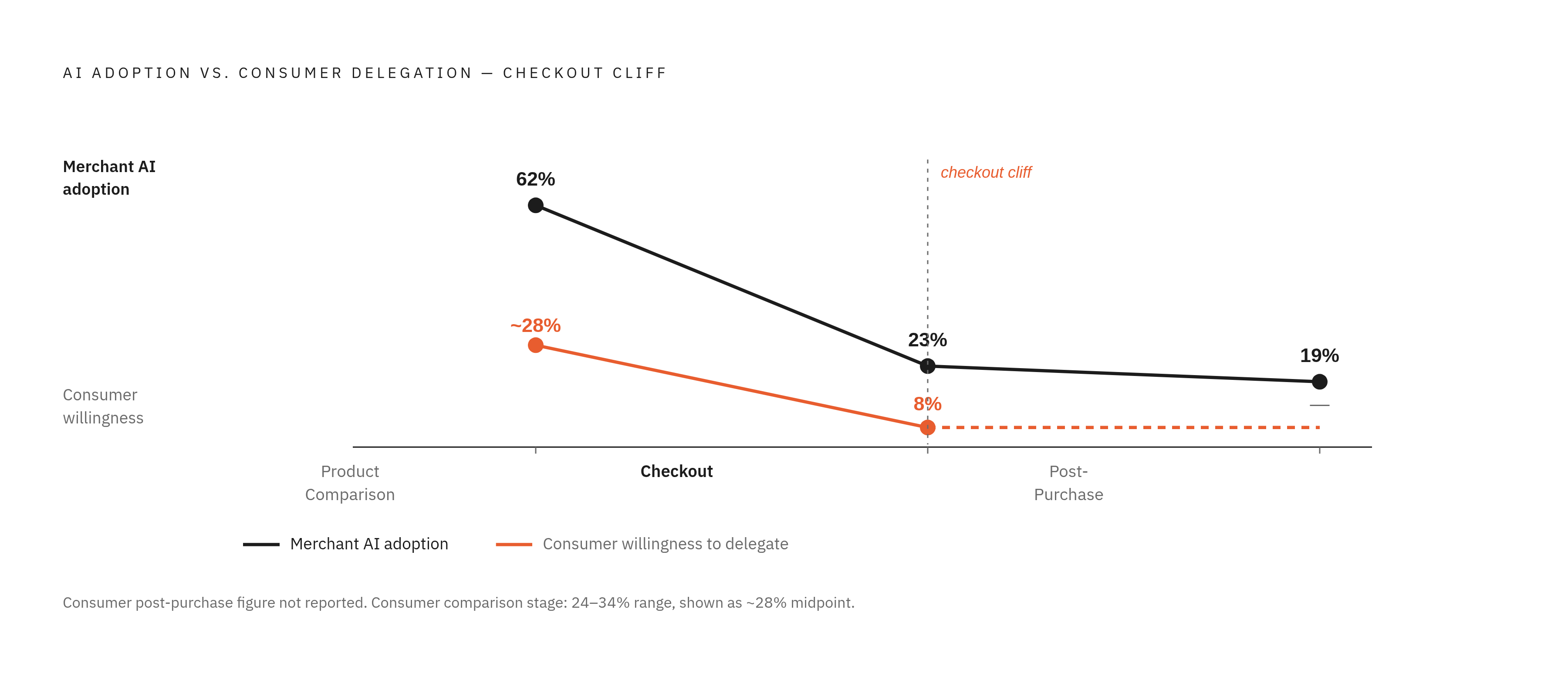
AI adoption in commerce sits close to 62% at the product comparison stage. By checkout it drops to about 23%, and for anything after purchase, it falls further still, to 19%. Consumer willingness tracks nearly the same curve. Commercetools found that 24% to 34% of shoppers say they'd hand comparison and price-hunting tasks to an agent, but that number collapses to just 8% once the task in question is checkout.
Putting those two curves side by side makes the shape of the problem obvious. Agents get trusted exactly where money hasn't changed hands yet, and get shut out right where a transaction actually requires someone to hand over payment. So when Adobe Analytics data, cited in Elogic's analysis, shows AI traffic converting 42% better than non-AI traffic in March 2026, up from 38% worse in March 2025, that reversal is a discovery story, not a checkout story. Adobe also found the channel grew 393% year-over-year by Q1 2026. None of that growth means agents are quietly closing more autonomous purchases. It means agents are doing the browsing, and a human is still the one who pays.
The trust gap at the moment of payment
The sharpest number in this whole conversation comes from a Logica Research survey run for Commerce and PayPal: 63% of Australian shoppers said they were interested in trying agentic shopping tools, but only 4% wanted AI help at the point of payment. Nearly the entire interested population draws a hard line right before the transaction closes, and that line is the whole story.
Accenture calls this the delegation dial, and the name earns its keep. Trust doesn't flip on or off, it moves in stages. Seventy-four percent of consumers will delegate routine commerce tasks to an agent, 32% will let an agent pick a product as long as the consumer still authorizes payment, and just 9% are open to a fully autonomous purchase, payment included. The same shopper who lets an agent handle grocery reorders on autopilot might refuse to let one anywhere near a flight booking. Stakes and category move the dial in ways a single trust score never captures.
Checkout.com's survey explains why the dial jams where it does. Twenty-seven percent of consumers trust no organization to run a shopping agent on their behalf. Twenty-four percent say they'll never delegate a purchase to AI, full stop. Forty-two percent cite fear of losing control over what actually gets bought, and that last figure is the one that matters most: the resistance isn't about the technology breaking down, it's about a shopper losing sight of the decision as it gets made.
How a trusted payment brand in the loop changes agent authorization rates
Visa CEO Ryan McInerney has said roughly three-quarters of consumers don't trust agentic platforms to make payments on their own. Read alone, that number looks like a wall agentic checkout can't get past. It isn't, once a familiar payment brand sits inside the flow.
Commercetools, citing Visa's own data, found that 61% of consumers say they'd trust an agent-led payment if Visa were involved somewhere in the process, and that climbs to 71% among people who use large language models weekly. Consumers aren't trusting the agent any more than before. The trust attaches to Visa, the rail underneath it, because Visa's presence makes them willing to proceed. A shopper who wouldn't hand a stranger their card number hands it over without hesitation to a payment processor used every week, even with an agent initiating the charge.
That has a direct, practical consequence for merchants, and most treat it as a footnote rather than a decision. Which payment brand or protocol sits inside an agent checkout flow is a conversion lever on the same order as page load speed or return policy, not a backend detail to leave to engineering. Whoever's logo appears at the authorization step is a business call, and merchants who bury that decision inside the tech stack will lose completions they never even see fall off.
Why agents abandon carts for reasons different from humans
Cart abandonment overall sat at 70.19% globally as of 2025, a number retail has lived with for years. That headline number hides two entirely different stories depending on who's walking away.
Human shoppers bail over price shock, distraction, a surprise shipping fee, a checkout form with too many fields. Agents don't get distracted, and a shipping fee doesn't make one flinch. What stops an agent cold is structural: a forced account-creation wall, a visual CAPTCHA it can't solve, a delivery estimate written as loose prose instead of a structured field, pricing that only renders after a client-side script runs, a variant picker that's ambiguous about which option maps to which listing, a session timeout tuned for human click speed instead of execution speed.
Before early 2026, most agents read pages the hard way, either parsing raw HTML through the DOM or using computer vision to interpret a screenshot of the rendered page. That approach breaks easily. One changed CSS class, one pop-up injected mid-session, and the whole flow fails silently, with no error message pointing a merchant back to the cause.
The protocol layer that determines whether an agent can complete a checkout at all
Three open standards now compete to define how an agent actually finishes a purchase, and each one carries its own costs, its own reach, and its own limits on which merchants can plug in. Picking the wrong one to build around first means a merchant ends up rebuilding checkout twice.
ACP, the Agentic Commerce Protocol, comes from OpenAI, Stripe, and Meta, launched in September 2025. It powers checkout sessions inside ChatGPT and, as of early 2026, processes live transactions for Etsy, with plans to reach over a million Shopify merchants. OpenAI's original Instant Checkout feature got retired in March 2026 after only a small number of Shopify's millions of merchants ever turned it on, a rounding error against the platform's total base. ACP survived the retirement by shifting to a lighter model: agents handle discovery and recommendation, then hand the shopper off to finish the purchase on the retailer's own site. PayPal joined the protocol on October 28, 2025, and Stripe shipped its Agentic Commerce Suite on December 11, 2025. Merchant margin absorbs the protocol and processing fees on every completed ACP transaction, and shoppers pay nothing extra.
UCP, the Universal Commerce Protocol, has been publicly available since January 2026, co-developed by Google and Shopify with Etsy, Wayfair, Target, and Walmart as supporting partners, and endorsed by a wider group that includes Adyen, American Express, Best Buy, Mastercard, Stripe, Visa, and Zalando, among others. UCP-powered checkout has been reported as live with major US retailers, with broader international rollout expected to follow. When something blocks autonomous completion, a CAPTCHA, a missing address field, UCP's checkout logic is designed to hand the shopper cleanly to a human-facing page instead of failing without explanation. There's no protocol fee, but participation is gated rather than open to all merchants immediately. Merchants are choosing right now, whether they realize it or not, between free but gated and ACP's fee but open.
MCP, the Model Context Protocol, comes from Anthropic and solves a different problem. It standardizes how an agent connects to outside data sources, tools, and APIs, letting it discover and query unfamiliar systems in a structured way. It's the connectivity layer that lets an agent find and read a system before ACP or UCP ever gets involved in completing a purchase. Merchants that treat MCP as interchangeable with ACP or UCP are confusing the plumbing with the checkout itself.
What merchants must get right in their product data and catalog infrastructure before protocols matter
None of the three protocols above matter if an agent can't find and understand a merchant's products first. That's a catalog problem, and it sits upstream of checkout in every sense that counts. Most merchants underinvest in it for that reason.
Agents don't browse the way people do. They don't scroll a ranked list of search results and click the third link down. They read structured attributes directly: price, stock status, shipping speed, review scores, fit against whatever the shopper asked for, pulled from data fields rather than from a rendered page. A merchant with clean, structured, machine-readable product data gets surfaced and recommended. A merchant with gaps, missing fields, or inconsistent formatting gets skipped, often without ever knowing a query happened.
Four things need to happen before any protocol conversation is worth having: audit the current catalog for structured attributes, product context, availability data, and schema gaps, since most merchants have genuinely never checked. Audit the current catalog for structured attributes, product context, availability data, and schema gaps, since most merchants have genuinely never checked. Enrich and govern that product data so fields and descriptions answer the specific questions agents are built to ask. Prepare feeds with the required fields, correct channel formats, live inventory counts, and pricing that refreshes often enough to stay accurate. Then measure it: set an AI visibility baseline, track how often the merchant's products get found, where they rank, and how that shifts once the catalog fixes go live.
This is where invisible abandonment traces back to its root cause. If delivery-estimate data is unstructured or stale, an agent doesn't wait around to find out; it drops the merchant from consideration before a checkout session ever starts. That failure is invisible in a cart abandonment report, because no cart existed to be abandoned.
Measuring completion rates when the most important abandonment leaves no analytics trail
Standard funnel analytics track a human clicking through pages: view cart, enter shipping, enter payment, confirm. Every drop-off leaves a session, an event, a timestamp behind it. Agent abandonment usually happens before any of that exists. No page load, no session, no cart record, just demand that silently never arrives at the merchant's site.
The metrics that actually matter sit upstream of checkout, then. Found rate answers whether the agent surfaces a given merchant's product for a relevant query. Price and availability match rate checks whether what the agent sees lines up with what the merchant's live site shows, and a mismatch here kills trust fast. Agent verification and mandate completion rate tracks whether authorization requests finish or get dropped for security or scope reasons partway through. AI-referred conversion needs to get measured against contribution margin, not top-line revenue, because a 4% ACP fee stacked on standard processing changes what "profitable" even means for that channel.
The swing from 38% worse AI conversion in March 2025 to 42% better in March 2026 didn't happen because checkout pages got prettier. Merchants started fixing the upstream signals, find rate, data accuracy, feed quality, since those are what control whether an agent shows up. Merchants that went further, building their own shopper-facing agents instead of waiting on someone else's, saw 6.2% sales growth versus 3.9% for merchants that didn't, a 59% gap. That gap matters past the growth number itself, too: a merchant running its own agent collects first-party behavioral data no ad network will ever hand over, which turns agent deployment into a measurement instrument as much as a sales channel.