LLM-as-Judge Reliability in Agent Pipelines
Deployment context determines whether LLM judges work, not model quality alone.

LLM-as-judge reliability in agent pipelines comes down to where you deploy it, not whether the underlying model is good enough. The method holds up cleanly on some tasks and falls apart on others, and recent research finally draws that line with enough precision to say which is which. Several fault zones matter here: how the founding benchmark study got misread, how bias survives past the point most teams stop checking, and a structural wall in agentic tool-calling that no amount of extra model scale seems to clear.
LLM-as-judge's default status as an evaluation method and its original promise
The paradigm traces back to Zheng et al., whose founding result showed GPT-4 agreeing with human evaluators more than 80% of the time, roughly the same rate at which two human evaluators agree with each other. That single number did a lot of work. It gave teams license to swap out annotation pipelines, contractors, rating platforms, review queues, for API calls, and it scaled fast. DoorDash's use of LLMs to grade search result pages is one of the clearer public examples of how fast this went from a research finding to production infrastructure.
The 80% figure carries less weight than the industry gave it credit for. It describes performance on the specific tasks it was measured against, and failure cases don't spread evenly across task types: they cluster. The figure describes performance on the tasks it was measured against, mostly open-ended text and preference comparisons, while teams now point these judges at multi-step, tool-calling agent pipelines. Borrowing a benchmark's headline number and applying it to a different task category is where most of the reliability trouble starts.
How standard validation metrics hide their own failures
Most judge validation in the field still relies on exact-match agreement between the judge and a human label. That metric doesn't correct for chance, so it overstates how good the judge actually is at telling responses apart. It's the single most common mistake in how teams grade their own graders, and it's an easy one to fix once you know to look for it.
The size of the gap is the real story. Norman et al. found exact-match agreement and Cohen's kappa, a statistic that does correct for chance, running a wide gap apart on MT-Bench, and it held across all 21 judges tested, regardless of provider. A judge that looks strong on the number teams report can be sitting close to chance-level discrimination on the same inputs. That's a different verdict about whether the tool works, not a calibration footnote.
Rankings compound the problem. In the same study, judges moved by as much as 14 positions depending on which benchmark scored them. A judge sitting near the top of one leaderboard can land near the bottom of another. Picking a judge because it topped somebody else's benchmark buys no guarantee it holds that position on the task actually running in production.
Position bias: stable, model-specific, and not a sampling artifact
Position bias, the tendency for a judge's verdict to shift depending on where a response sits in the prompt, isn't noise you average away. Lin Shi and colleagues studied it across 15 judges and roughly 150,000 evaluation instances, and found the bias varies meaningfully by judge and by task. More samples don't fix it.
The behavior takes two forms. When two candidate responses swap positions, a judge either flips its verdict (repetition instability) or holds firm (repetition stability). The research distinguishes judges that held their verdicts from those that flipped based on prompt order.
Anyone leaning on test-retest checks as a validity signal should worry about this. Two judges already running in production, Qwen 3 8B and Gemini 2.5 Flash, post test-retest reliability above 0.95, essentially returning the same answer every time you ask, while simultaneously showing position bias above 0.10. The most reproducible judges in the study are among the least valid ones. A judge locked onto position instead of content will replicate its own answer with total fidelity, so consistency is not the same as accuracy. It's just repeating the wrong answer, faithfully, and a standard reliability check will never catch it.
Verbosity bias, self-preference, and familiarity bias: three ways content-independent cues distort scores
Verbosity bias, judges rewarding longer answers whether or not the extra length adds anything, dominated the 2023 literature on this subject and was large enough to make length alone a meaningful predictor of who wins a head-to-head.
Norman et al.'s later numbers show real movement: all 21 judges in the cohort scored below 0.011 on verbosity bias under a single pairwise rubric. That's genuine progress over the earlier literature, but it comes with a catch. The reduction is tied to that specific rubric format and doesn't automatically carry over to other setups. Changing the rubric can bring the bias right back.
Self-preference bias runs alongside it: judges tend to inflate win rates for outputs their own model generated. Preference alone wouldn't be disqualifying. The trouble is that the preference tracks the source of the text rather than anything about its quality. Familiarity bias works the same way from a different angle. Judges tend to score text that reads as more familiar to their training distribution higher than equally good text that sounds less native to that particular model.
Prior prejudice: when a judge's trained beliefs override its assessment of argument quality
Research presented for ACL 2026 out of UIUC's Conversational AI Lab reveals something more troubling than a stylistic tic: models conflate their own alignment-instilled beliefs with rhetorical quality. Tested through persuasion evaluation, where a judge rates how well-argued a claim is, the models rated identical claims differently depending on whether the claim agreed with positions baked in during alignment training, not on the strength of the argument itself.
The size of the effect is hard to write off as noise. A bare, one-sentence assertion that aligns with the model's trained beliefs scored up to 3.4 points higher on a 6-point scale than a structurally identical opposing claim, a 57% swing generated entirely by whether the judge agreed with the content, with zero difference in rhetorical construction.
What makes this worse than a simple blind spot is that the models often know better. In 88% of the failure cases studied, the model's own reasoning trace explicitly notes missing evidence, then goes on to assign a high score anyway, reaching for phrasing like "generally accepted truth" to paper over the gap. Telling the model to fix this doesn't work either. Four separate prompt variants, including direct instructions to judge rhetoric independent of agreement, failed to reduce the bias in harmful-content and misinformation categories. In 35 to 43% of those conditions, the explicit instruction to stay neutral made the bias worse.
Rubric interference and the broader bias taxonomy production pipelines rarely audit
A newer finding, and a separate one: the composition of a multi-criterion prompt can itself influence individual scores, a pattern distinct from inter-response biases like position and verbosity.
Practically, that means the shape of a multi-criterion prompt is itself a variable in the experiment. Adding or dropping one grading criterion can move every other score on that rubric.
The catalogued bias list runs a lot longer than the four most commonly cited. Researchers have documented a range of additional biases beyond those most commonly cited in production audits. Most of these never make it onto a standard production audit checklist.
Language compounds all of it. One tested judge model's reliability fell from 0.714 in Hindi to 0.550 in Swahili, with order consistency dropping further in Swahili. Raw accuracy numbers, 0.835 versus 0.660, look bad on their own but actually understate the real gap, since accuracy alone doesn't capture how much of that Swahili performance comes from unstable, order-driven judgments rather than genuine assessment.
The structural ceiling in agentic tool-calling that more capable judges cannot overcome
Everything above concerns text evaluation: open-ended answers, pairwise comparisons, persuasion tasks. Agentic tool-calling, judging whether an agent called the right tools in the right order across a workflow, is a different animal. AgentJudgeBench is the first benchmark built to study LLM-as-judge reliability specifically for that setting, as distinct from open-ended text or preference judgments.
The scale is substantial: 3,808 instances spanning six DAG topologies and three difficulty tiers, scored by five different generator models and six judges ranging from 20B parameters up to frontier scale.
On hard queries without access to ground truth, all six judges, regardless of size, converge to a narrow 77 to 82% alignment band. A judge built on a much larger model is in the same band as one a fraction of its size. That's a structural ceiling, not a scaling problem, and it means the usual fix for a weak judge, upgrading to a more capable model, doesn't apply here. Alignment also degrades as task difficulty rises, and it degrades 1.5 times faster when ground truth isn't available than when it is. That gap points at the real cause: the ceiling comes from the absence of a verifiable answer to check against, not from any shortfall in model competence.
The catches and routing of a deployed multi-turn agent judge, away from view
A study of a deployed multi-turn food-and-beverage ordering agent, checked against exhaustive human transcript review as the ground truth, shows what this ceiling looks like in an actual production system. Across three batches, the judge caught well under a quarter of the systematic problems humans confirmed: 2 of 9 patterns (22%) in one batch. In another batch, the judge's operational gate flagged zero of 100 rounds, while human reviewers confirmed 23 distinct defects in that same batch.
The miss isn't random. It has a shape. What the judge catches tends to be turn-local: a fabricated statistic inside one response, a reply given in the wrong language. What it misses is state that spans turns, including a confirm-gate that locks a user out, a cart that hallucinates items never added, an escalation path that locks up, or a reference to something said several turns earlier that no longer resolves correctly.
Misrouting drives the deeper issue. The raw judge notices most of these defects on a majority of rounds; the signal sits right there in the underlying model output. But of 114 defect notices generated, 113 got filed under "brand voice," because the rubric simply had no other category to put them in. The judge saw the problem and had nowhere to file it.
When LLM-as-judge is and isn't appropriate to deploy
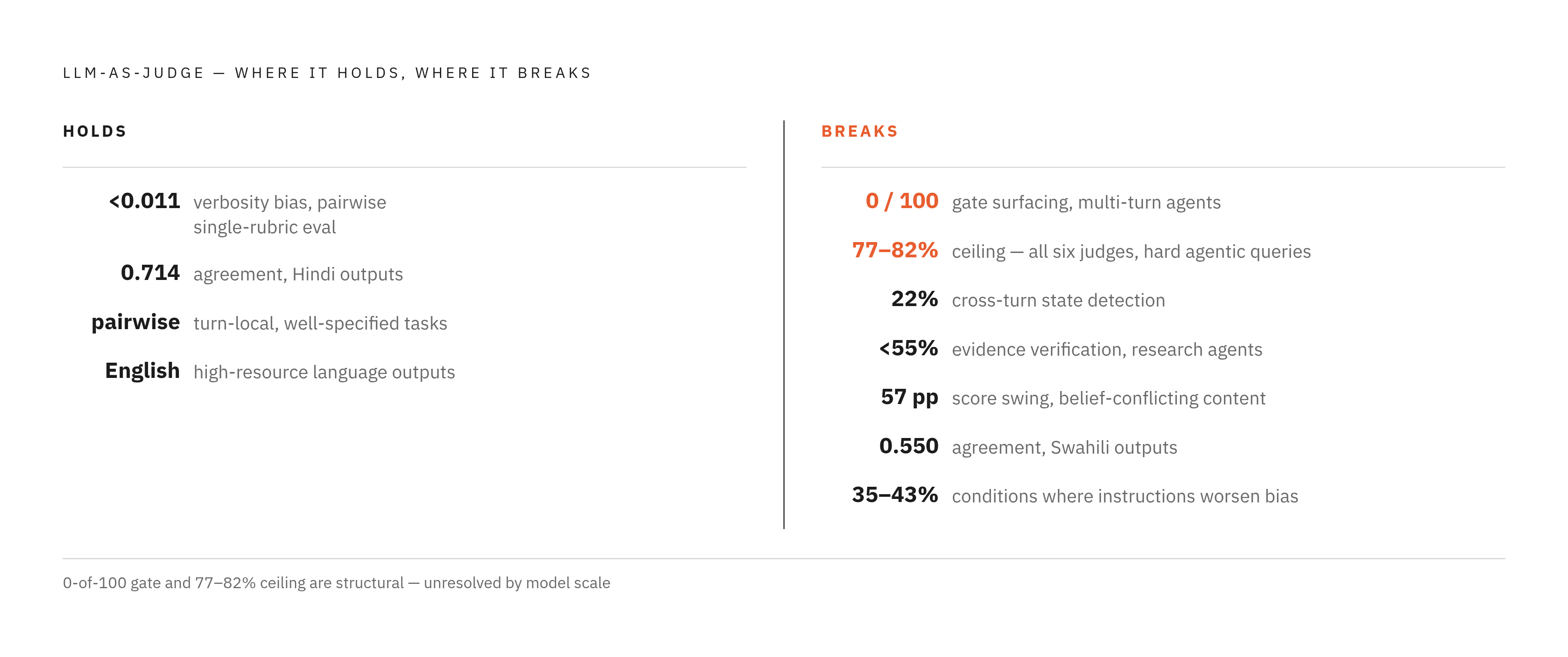
None of this makes reliability a yes-or-no property of a given model. It's conditional: on the task type, the rubric design, the language, whether the evaluation is pairwise or single-answer, and whether trustworthy ground truth exists to check against.
The approach holds up on turn-local, well-specified evaluation tasks where the rubric actually matches the failure modes being watched for. It holds up on English-language outputs, where the cross-lingual degradation documented above doesn't come into play. And it holds up on pairwise evaluation under a single, well-designed rubric, where verbosity bias is now small enough, below 0.011 in the Norman et al. cohort, to stop being a first-order concern.
It breaks down on cross-turn state tracking in multi-turn agents: the ordering-agent case above is the clearest documented example, with detection at 22% and gate surfacing at zero, across 220 checked rounds. It breaks down on evidence verification in research agents, where accuracy for even the best-performing models stays below 55%. It breaks down on hard agentic queries without ground truth, capped at that 77 to 82% band no matter how large the judge gets. It breaks down anywhere the judge's trained beliefs conflict with the content it's asked to grade, since instruction alone hasn't been shown to fix that. And it breaks down across multilingual pipelines that include lower-resource languages in scope.
Panel judging, running several models and combining verdicts, gets pitched as the fix for individual bias, and averaging across judges does smooth out some of it. But research has found that the apparent diversity across a multi-judge panel can be largely illusory once inter-model correlations are untangled. Adding more judges to a panel cannot replace the work of building a rubric that matches the failure modes teams actually need to catch.
Sources
- Time to Reflect : Can We Trust LLM Judges for Evidence-based Research Agents?
- BabelJudge: Measuring LLM-as-a-Judge Reliability Across Languages and Agent Trajectories
- LLM-as-a-Judge: Why Frontier Models Fail 50%+ Bias Tests
- Reliability without Validity: A Systematic, Large-Scale Evaluationof LLM-as-a-Judge Models Across Agreement, Consistency, and Bias
- AgentJudgeBench: A Multi-Difficulty Benchmark for Evaluating LLM Judges on Agentic Tool-Calling
- uiuc-conversational-ai-lab.github.io